Friday, 5 August 2022

Beasties and Battles

After the last night in the campervan for this trip I made my way to the Dunblane Hydro for the event that prompted  the whole trip. I did pay a couple of visits on the way though. 

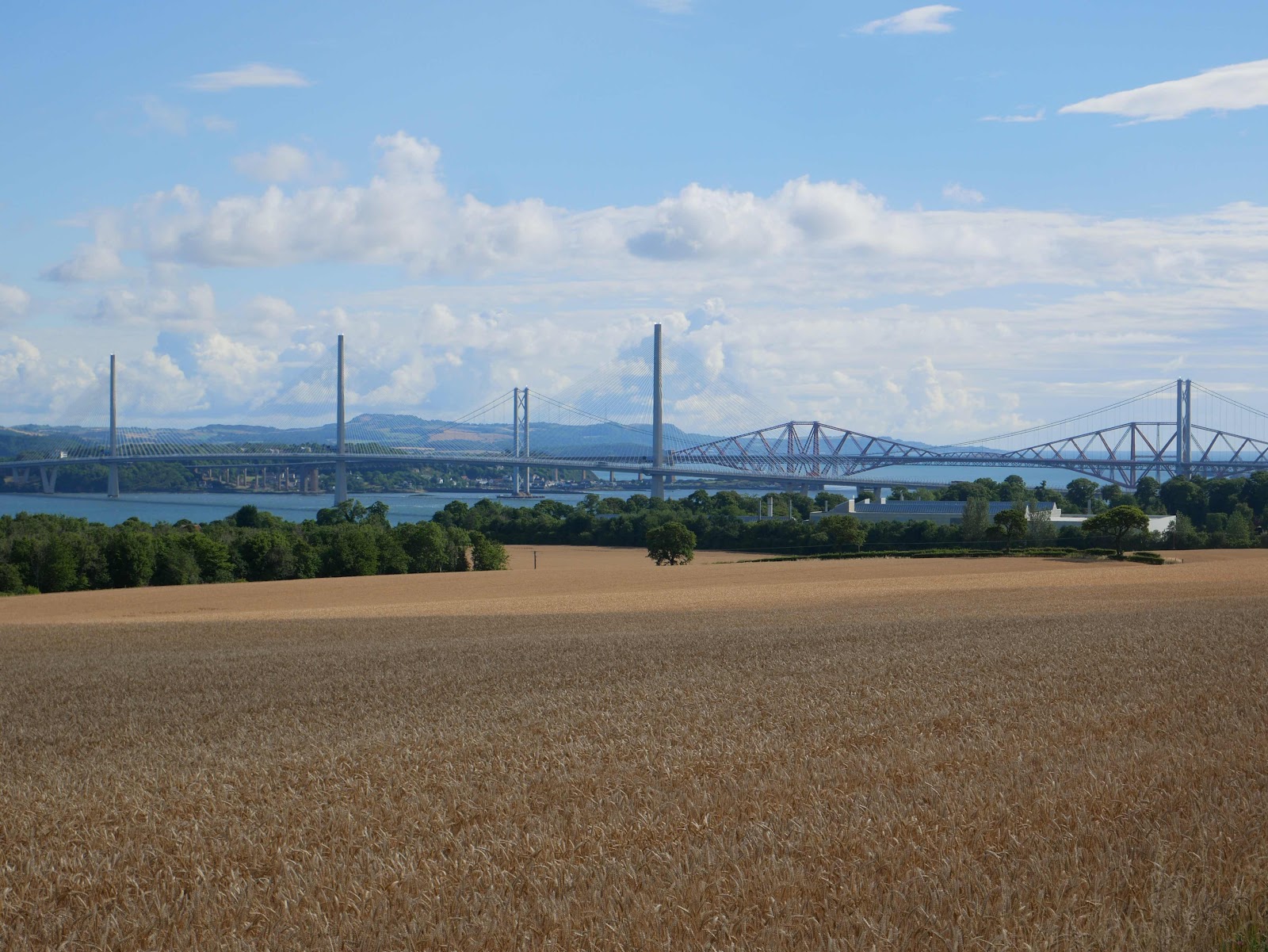
When I was out earlier in the week I’d found a viewpoint for the Forth Bridges, unfortunately they’ve let the hedges grow so high it’s difficult to get a good picture which rather defeats the object. It was only as I was driving out that I realised I only had to walk a few yards down the road for an interrupted view. As I was driving past the same point I stopped again and spent a few minutes capturing some shots. I’ll only know when I get them on the computer how well the worked but here’s one to be going on with. 


I last visited the Kelpies on a freezing cold December day so was pleased to go back in somewhat warmer conditions. For anyone who doesn’t know, Kelpies are mythical horse like creatures that inhabit streams and rivers. The statues were erected as part of the Helix Park development, the initial concept had been that they’d actually move as part of pumping water for the canals but that proved impractical - they weigh over 300 tonnes each! They are a tribute to the heavy horses that worked in Scotland on the land and hauling boats. 
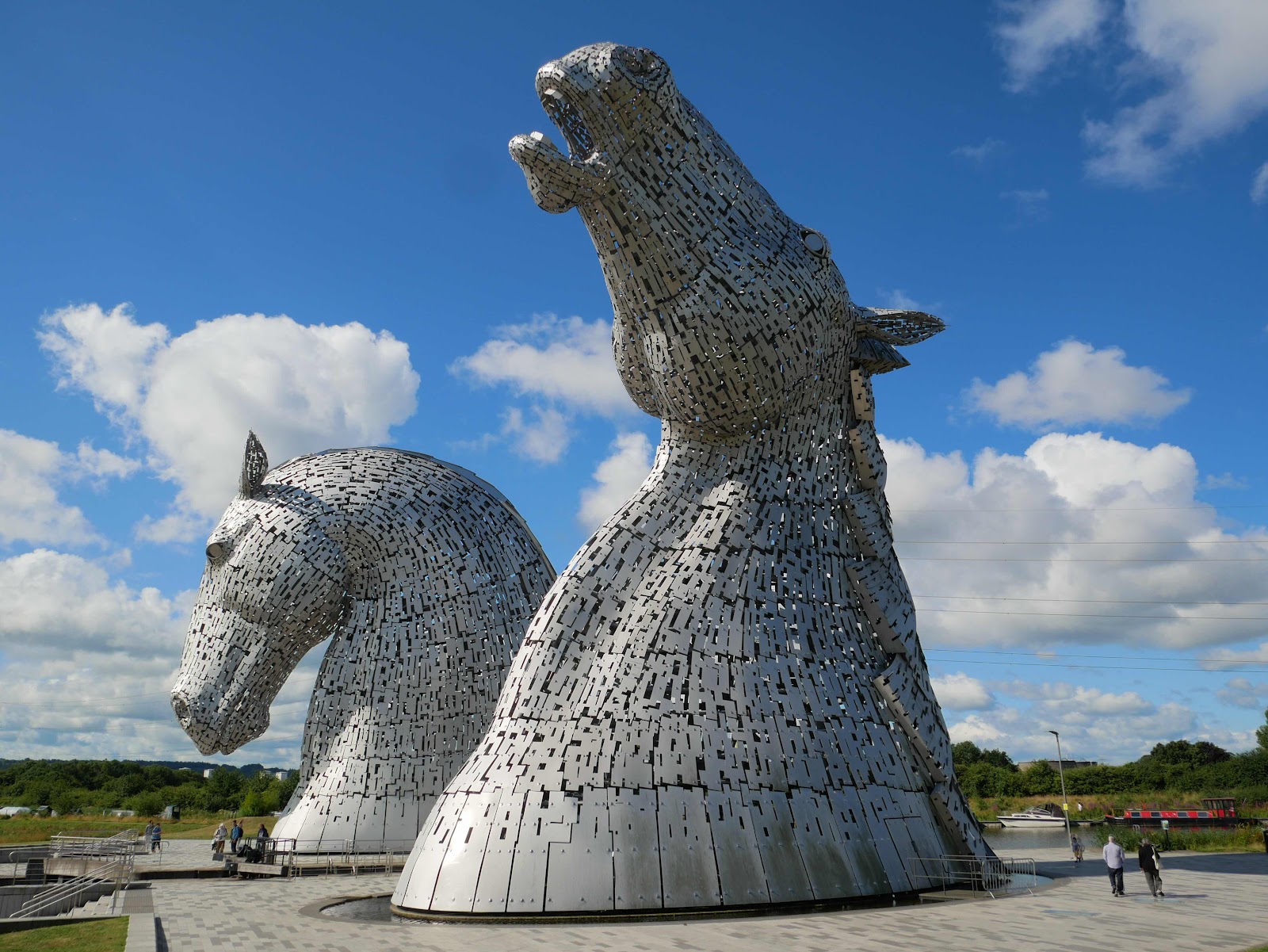


The mottoes alongside are Bow down your strong heads to taste the water,  Stretch up your long necks to face the sun and Echo the great beasts that work among us. I’ll be entering the best of the pics in a calendar competition and I’m hoping I can incorporate the mottoes in the image. 

The final visit was to the Battle of Bannockburn Visitor Centre. I accepted the option of the guided tour, at a bargain price! It should have been £7.50 however she put it though as a senior without checking (if I’m asked I’m always honest, if not it’s their look out) and then discounted it to £3 due to problems with the large screen displays. The guide was American, which seemed slightly odd but she was good and I guess neutral in describing a battle between the Scots and English! The engineer was working on the display technology and wondrously it started working just at the right moment. The presentations were a bit cartoon like in places but you did get a clear sense of his things were and it’s quite spectacular having a volley of crossbow bolts start on your right on one huge screen, shoot across in front of you then hit the Scots on the screen to the left - graphic but it got the point across. 

The guide did talk a little about the difference between longbows and crossbows but omitted a crucial point, even though the presentation illustrated it. The crossbow may be more powerful and need less expertise to fire but the longbow has a much higher rate of fire. In any case the English bowmen were at the wrong end of the battlefield when the Scots attacked and when they tried to gain the higher ground on the flank they were turned off by the enemy cavalry. Had it not been for that they would have been able to fire on the Scots and the result, and history, may well have been very different. One oddity about this battle is there are virtually no relics of any kind, the victorious Scots stripped the field bare afterwards. 

With the weather being very variable, sunshine and drizzle with intermittent heavy rain, I decided to head straight on to the hotel at that point. Thoughts of a peaceful afternoon were somewhat destroyed by a large and boisterous wedding party but gradually the friends assembled ready for a couple of days of fun and frolics. 


Wednesday, 3 August 2022

Planes and Flags

I did warn that today would be about aeroplanes and it is, amongst other things! Apologies for a lack of photos, they’re refusing to publish but I’ll try and rectify this. 

The National Museum of Flight’s iconic image is Concorde as it’s the home of one of the few remaining examples, it would have been natural for me to include a picture but it’s nigh on impossible to photograph it due to how it’s displayed and the fact it almost fills the hanger so I photographed a Vulcan instead. 

The only problem with Vulcans is they’re fairly common, that’s the third one I’ve photographed in the last few years. I think that’s partly their status but also by the time they were taken out of service the museums were established and able to take them on. 

The museum does a good job of displaying, and telling the stories of, both civil and military aviation. It’s not all planes, either, there’s a section of interactive exhibits for children to learn about engineering and the theory of flight. 

During World War One East Fortune Airfield was home to both planes and airships, used to try and spot enemy shipping and submarines and as part of the defence of Edinburgh. Unfortunately they weren’t successful in the latter role and the city was bombed by Zeppelins L14 and L32 in the night of 2nd/3rd April 1916, leaving 13 dead. One of the bombs failed to go off and is now in the museum. 

This has personal significance because the night before  L11 had dropped bombs on Sunderland killing at least 22 but potentially saving my grandmother’s life. The family story is that the raid brought on premature labour and had the pregnancy gone to full term Nan would have been still-born. The dates fit so it’s quite probably true that without a bomb like the one displayed I wouldn’t be writing this now. 

The weather was very variable, bright sunshine one minute, miserable drizzle the next with the occasional downpour so having seen everything and just about stayed dry I had a very nice toasted ciabatta in the cafe before departing to play Brown Sign Bingo. 

On the way to the museum I’d noticed a brown sign for the Flag Heritage Centre which intrigued me so I went there after leaving the museum. The story is that the Scottish Saltire, a white cross on a blue background, was created after a battle between the Picts, led by Angus mac Fergus, and Scots against the Angles and Saxons under Athelstan. The area was under Northumbrian rule and the former had been on a raid when they were caught and made a stand near what is now the village of Athelstaneford. 

King Angus feared the outcome and led prayers for deliverance, being rewarded with a cloud formation of a white St Andrew’s cross against the blue sky. The Scots won the day, the saltire became the flag of Scotland and St Andrew became their patron saint. 

The Heritage Centre is housed in a 16th Century doocot (pigeon loft to the English) at the back of the church where there’s also a memorial. These buildings were fairly common and have been described as the “medieval deep freeze” since the pigeons provided meat when nothing else was available. At the time only breeding livestock were generally fed through the winter as there wasn’t enough food available, the meat animals were slaughtered in autumn contributing to what’s known as the Hungry Gap. Pigeons took minimal looking after and were self feeding so filled in the lack of meat but the advent of turnips and other root crops for animal feed largely solved the problem and they became less popular.

Tuesday, 2 August 2022

Railways at Borrowstounness

Yes, Borrowstounness is the full name of Bo’ness, you can see why it’s generally shortened! 😊

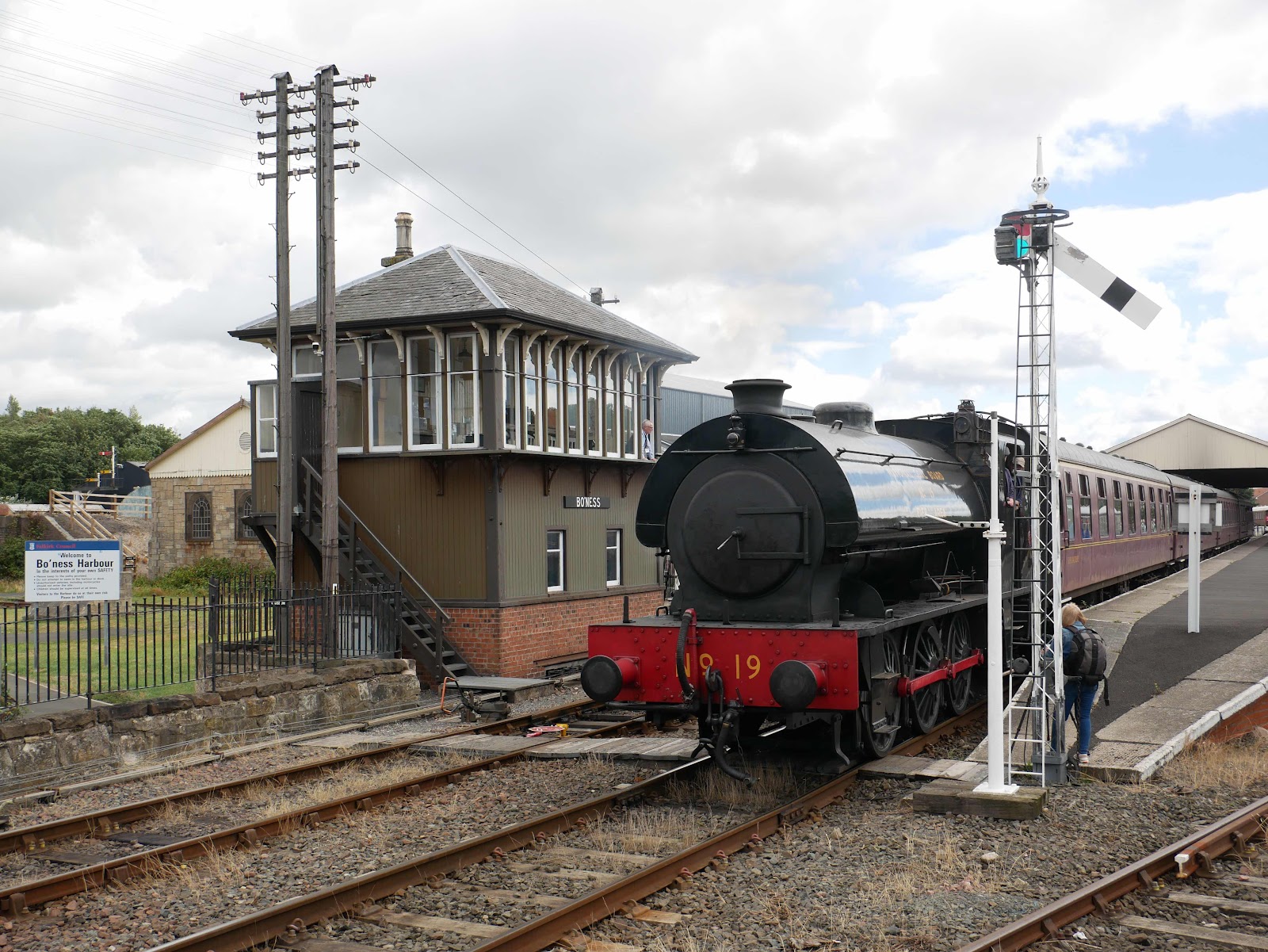
The Bo’ness and Kinneil Railway, and adjacent Museum, have been high on the visits list for ages - that’s the theme of this trip, crossing off some of the bucket list! Like many places they’re struggling a bit to merge old and new technologies; you’re asked to book online and either print out the email or have it on your mobile so they can scan the barcode, total waste of time as the barcode scanner won’t work at all with phones and struggles with any printed version that’s been folded (the barcode is right in the middle of the page!) So as the queue built up, the one prebooking is supposed to prevent, they resorted to finding people on their printout and crossing them off when issuing tickets. 

Motive power for the day was an ex-NCB Hunslet tank engine:


Post-COVID you’re allocated to a coach, which was no problem except it was full of railway photographers -see the anoraks! πŸ˜€ I had a bit chat with some of them, all friendly, and got a few photos of the journey. It’s quite a scenic line in some respects as you’ve got the sea one side and woodland the other, but then you also go past Grangemouth oil refinery, albeit at a distance. The line runs up to a terminus at Manuel (Que?) which also has their link to the mainline, quite important as they’ve been working with companies developing battery and even hydrogen powered units, although typically these arrive by road! 

The museum was interesting enough, a few locos, wagons and coaches but very little memorabilia, this probably reflects the fact it’s all part of the SRPS - Scottish Railway Preservation Society. Being able to get very close to some wagons gave me more idea of brake mechanisms and a wooden hopper wagon also helped - several planks were missing so I could see the inside hopper arrangements. I rounded off the visit with a decent lunch in the buffet. 


I’d have liked to visit the Bo’ness Motor Museum but it’s only open on weekends so instead I called in at a farm shop I’d spotted for supplies - Ayrshire Bacon and Lorne Sausage will sort the next couple of breakfasts nicely. 

Monday, 1 August 2022

Small Pipes and Not So Small Pipes

I didn’t rush away this morning as the first target was the Chantry Bagpipe Museum in Morpeth. In hindsight with the way the trip worked out the site I was on wasn’t ideal as I first drove much of the same way as I did yesterday but that was partly down to a change of plans, I’d have been better stopping at a site a bit further north. It didn’t really matter, it’s nice countryside anyway! 

Problem one in Morpeth, how to pay for the car park. There seemed a dearth of ticket machines, so I assumed it must be free, on the way out I found the one single machine and yes, the sign said 24 hours free parking so that was a bonus. I was ready for a coffee so stopped off at the bus station cafe/deli (yes, it really is a bus station deli). I realised I’d been oop North long enough when I said, “Thanks, pet!” to the waitress. 😊

The Chantry Museum has been on the visit list for a few years now, ever since I went to Woodhorn Colliery Museum. I do have a liking for the Northumbrian Small Pipes, which are very different to the Scottish Highland Bagpipes in several respects, the main one being that you can listen to them close up (the latter are best heard from an adjacent mountain top to the piper πŸ˜€ ). The small pipes are the last surviving English pipes but it’s likely they owe more to the French Musette than the other British varieties, although they do have similarities to the Irish uilleann pipes. The museum does cover other pipes, including the Scottish Half Long Pipes, which I’ll confess I’d never heard of. 

The museum is combined with the tourist information, gift shop and poetry library. You’ll be pleased to know I didn’t buy a set of pipes (they don’t have any and I know my limitations) but I did add two books to my North East Steam collection, both of which may help with the current model build, especially as unusually  one of them includes colour plates - it’s difficult discerning liveries in black and white!

After a quick stock up in Morrisons I took the coastal route North with the intention of stopping off somewhere, unfortunately given that it’s August and the time of day I couldn’t get parked in either Seahouses or Bamburgh (or at least not near enough for it to be worthwhile) so I continued on. I’m not sure why but the SatNav brought me in to the Edinburgh  site, which is West of the city, along the waterfront instead of around the bypass. We last went that way about 45 years ago when a truck driver led Dad, towing the caravan, to the Forth Bridge. It was Festival time and they’d had a conversation in a lay-by short of the city, apparently everywhere else was gridlocked. I did get a glimpse of Britannia in passing but with road works and bizarre lane markings* I was having to concentrate. 

Checking in at the site was as smooth as usual, it’s not somewhere I’d choose normally but it’s in the right place! I’ve found a pitch at one end so at least I’m largely undisturbed by the traffic, with 148 pitches that can be a problem. Although it’s a city centre site it is well surrounded by trees but security is an issue, they provide secure bike lockers for example. 
 
*At one point there were bus stops on the left, the lane had a straight on arrow then suddenly became a right turn lane and you had to make the vehicle jump 10’ to the left! That caught three of us out. 

Sunday, 31 July 2022

Cragside and Slag Alice

The weather, coupled with a slightly later start than intended due to general lethargy, dictated a swap round in the day’s planned activities so the first visit was to Cragside. I’ve been wanting to go to the estate for many years but it’s not worked out previously so this was an ideal opportunity. 

The house was initially built as a hunting lodge then extended by George Armstrong, the armaments and engineering pioneer. Whilst providing the means of conquering and controlling the empire may be a bit dodgy these days there is no doubting his vision and innovation. He was actually trained and practiced as a solicitor before his interest in mechanical matters took over and he founded the manufacturing dynasty that built the mechanisms for the Low Level Bridge in Newcastle and the slightly more famous Tower Bridge amongst many other marvels. . 


The house itself is spectacular, perched on the side of a crag (hence the name) but isn’t all that grand in itself,  it was mainly a holiday home and place to entertain visitors, once the Armstrongs had purchased Bamburgh Castle they’d a much grander residence! In any case I wasn’t there for the house itself but to see the innovations introduced such as electric lighting (first incandescent bulbs used to light a room), a hydraulically driven lift and kitchen appliances, etc. it was also the first house powered by hydro electricity, something they still do when there’s sufficient water having installed a Reverse Archimedes’ Screw a few years ago. 

The electricity came about partly due to Armstrong’s friendship with Joseph Swan, one of my heroes. Most people will tell you that Edison invented the electric light bulb, however he didn’t! In fact several people were working on it independently at the same time. We do know for a fact that Swan demonstrated a sustained light (ie more than a second or so) before Edison. This lead to a patent dispute which was resolved by Swan holding the patents in Britain (and hence the empire) and Edison for the rest of the world. I understand that in reality Swan’s bulb wasn’t suitable for bulk manufacture so they set up the joint venture EdiSwan company to make and sell bulbs in the UK. The original table lamps are still in the house, although these days they have LED bulbs in and have been fitted with modern switches, originally they were turned on and off by lifting them in and out of dishes of Mercury. 

Armstrong was a visionary in that, at the height of the coal powered industrial revolution, he was already propounding the need for sustainable alternatives to fossil fuels, not for “green” reasons but the fact that the coal would  eventually run out. 

I’m not sure just how far I walked, probably about three miles and much of it was up and down and on some rough ground, so I reckoned I deserved lunch at the tearooms. One notable thing is that, for a National Trust property, they’re quite blasΓ© over health and safety. As examples, the steps down from the house through the rockery are steep and very uneven but you can still use them and to join the 6 mile carriage drive (and it’s well worth doing so) you drive through the archways and across the main courtyard of the house where visitors are wandering about. It would be difficult for them to do anything about either of these but it’s refreshing that they haven’t just closed them off. 

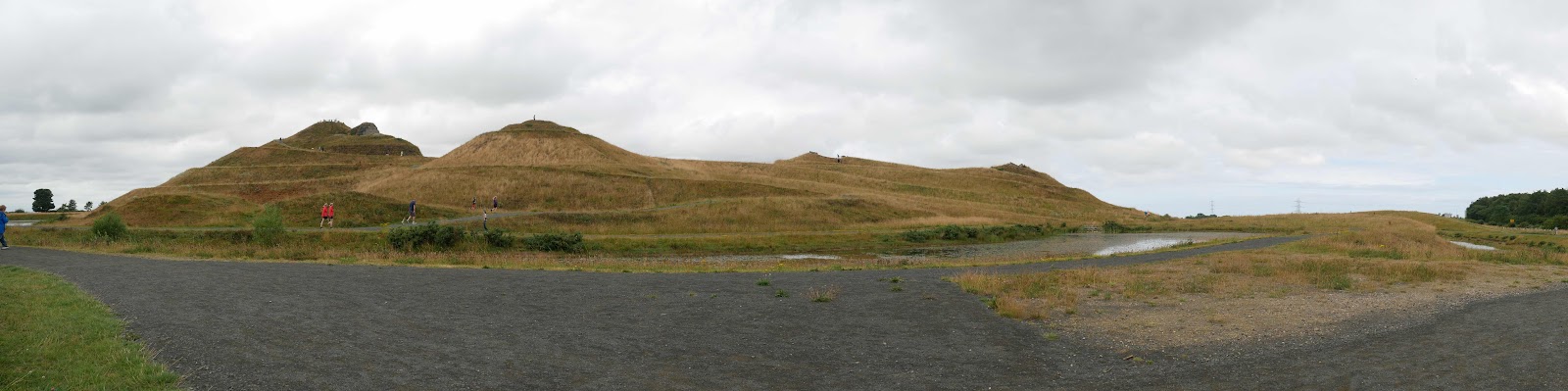
The second visit was to Northumberlandia - The Lady of the North or, as she’s generally known, Slag Alice! Many years ago the doyen of North East newsreaders, Mike Neville, did a parody report about a Northern Arts project involving digging holes in the ground and piling up the the waste, well it’s now true, sort of. The pit waste was readily available so Charles Jenks designed a huge sculpture of a lady made by piling it up. Photographically the visit was a bit of a waste of time as I didn’t have a helicopter handy and frankly even looking at aerial photos I have difficulty recognising it for what it’s supposed to be. 


If I didn’t know better I’d say it looks more Iron Age than modern day. 

Saturday, 30 July 2022

The Scottish Trip 2020 - A Late Start

Yes, the title is confusing, this trip should have taken place two years ago, but then COVID hit so it’s a very late start! The plans I made back then were a bit ambitious (particularly with the rise in fuel prices since then) so I’ve simplified them considerably.

It was actually an early start this morning as I wanted a haircut, the barbers I use open at 7am so having done that and had a coffee and sausage inna bun I was still on the road from Market Harbotough by 8. I’d largely loaded up the ‘van last night, trusting the fridge would stay cold, which helped. Not having the cycling kit gives me a bit more storage and the overhead Net worked for its intended purpose of being somewhere to put my suit (we have a posh dinner next weekend). 


It was as good a run up the A1 as I’ve ever had, despite warnings of doom and gloom with rail strikes and holidays, so I reached the first destination by 11:20. I’d been debating what to do on the way up but once I confirmed that the Bowes Railway was open that made my mind up. I’ve been before but I was hoping to get some decent photos of hopper wagons for the current model layout build. I wasn’t disappointed, I’ve got some good pics of three different hoppers and the Jubilee 5 plank wagons as well. At least two of those will be transferred to the 3D modelling program I use and printed on the resin printer. I also got some photos of various underground locos and wagons for a possible future project, although that will be some way away. 

You’re guided round most of the site and the guide we had was good, although I will say some of his tales were rather tall and he muddled up some facts, none the less he was entertaining. Having been a miner, fireman, mine rescue, etc. he did dwell on the loss of life, understandable when he was involved at Flixborough and various pit explosions. 

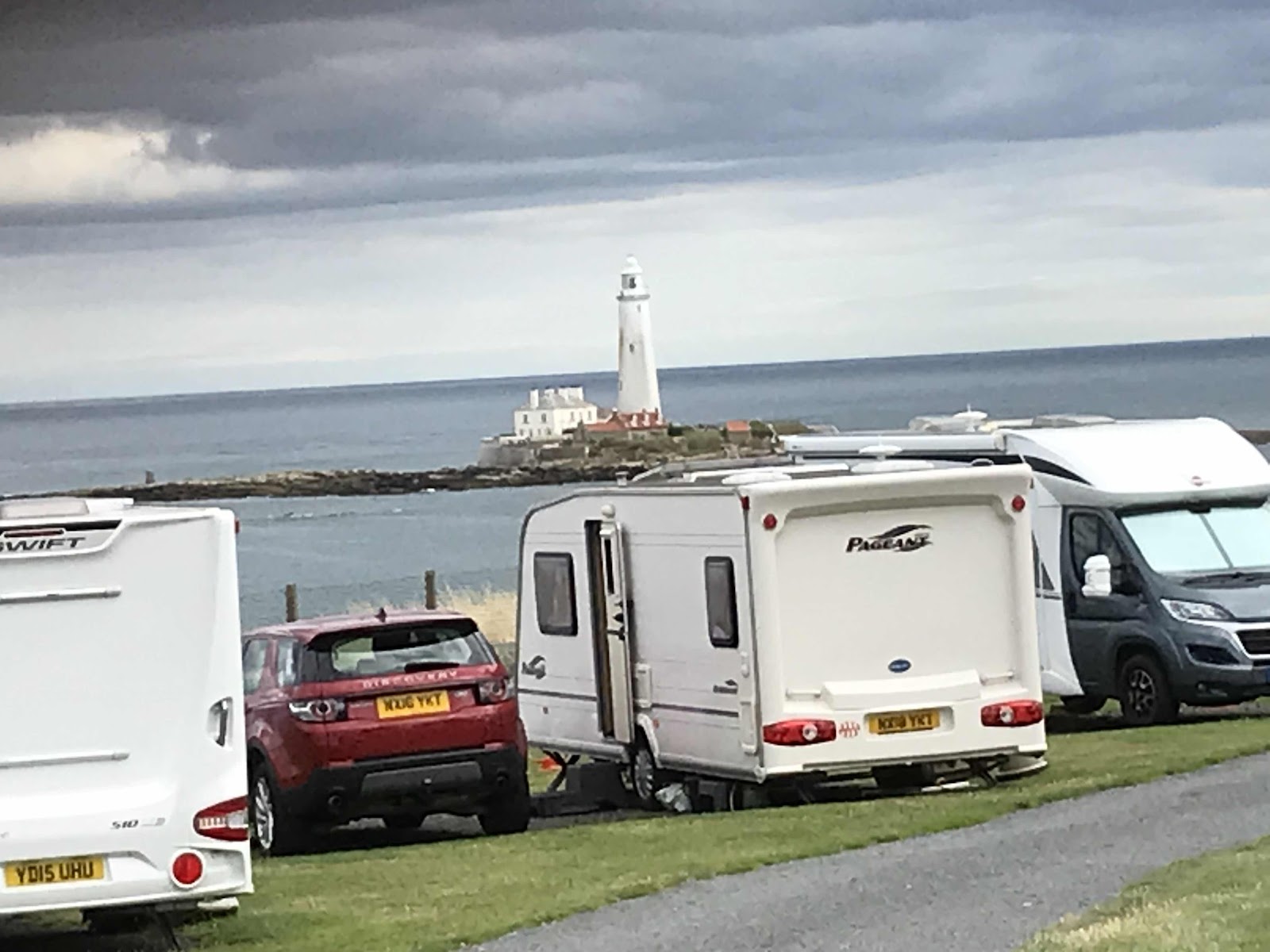
From the railway it was a quick trip through the Tyne Tunnel, they’ve gone over to pay on the ’net instead of at toll booths - I’m sure it took longer to sort that later than it had to actually get through! The site for a couple of nights is the Club one at Old Hartley near Whitley Bay; I’ve stayed here a couple of times before and whilst it’s not very spacious it’s ok. The view makes up for it though, helped by the fact it slopes down towards the sea, this was taken from the ‘van side door…


The phone camera was at maximum zoom so there’s a foreshortening of perspective, the ‘vans aren’t actually as close together as they appear.

Once pitched* (which consisted of putting out my Pitch In Use sign) and having had an ice cream from the reception I decided to go for a wander. One of the reasons I’m here is to try and get some decent photos of St Mary’s Island and the lighthouse. The sunshine died on me a little but I think I got some OK shots from a couple of locations, I may try again tomorrow afternoon if it’s sunnier. I walked back towards the site but then carried on past it to Seaton Sluice for a pint. I followed that with fish and chips overlooking the harbour, surprisingly it was a blackbird trying to mug me for the chips not a seagull, before walking back to site and settling in for the evening. 


*After my fridge works (see previous blog post) I decided I’d run it just on battery to see how well it holds up, if I have problems I’ll plug the mains cable in but otherwise it’s one less thing to unpack and pack away. 


Friday, 22 July 2022

Woe, Woe and Thrice Woe

I’ve been sorting some ‘van issues, some have gone well, others not so much. 

The buzzing from the audio was very quickly diagnosed - I could see daylight through the driver’s door speaker so with a little fettling, and some 3D printed spacers, a new pair of speakers were installed. It would have been a good idea to turn the volume down before testing though, the bass response is fantastic. 

I also fitted a new DAB aerial as it’s been showing No Signal for quite a while, unfortunately this hasn’t fixed the problem. I’m disappointed, especially as it took a couple of hours, but there’s not much I can do about it. 

The coolbox problems proved a lot more complicated! 

Back in 2021 I found the coolbox wouldn’t run off the battery overnight, but was OK during the day when the solar panel is charging. No real problem, I’m normally on hookup anyway but I diagnosed a dying leisure battery, probably from lockdown. Move on to 2022 and I installed a new battery prior to a weekend away without hookup, all worked perfectly, problem solved, except it wasn’t. A few weeks later I had a few days camping followed by a few days in a hotel, during the latter I found the coolbox wasn’t staying down to temp again. The compressor would fire up, run a short while then cut out, with no error showing. 

Possible issues were the wiring to the coolbox socket, another dodgy battery or the battery wiring. The first I tested by wiring in a direct feed from the solar panel controller. All seemed ok briefly but then the coolbox started cutting out. The useful thing was that having it on the controller I could see the voltage pulling down to 11.9 volts, sufficiently low for the battery protection to kick in. That eliminated one bit of wiring but strongly suggested the battery was faulty. Now you do occasionally get a duff battery but it’s unusual so my worry at this point was it had been “cooked” and I had a charging system fault. 

The next test was to remove the battery, which was showing fully charged, and test it off the ‘van. The green indicator was showing, a good sign, and a quick check showed no shortage of fluid, which suggested it hadn’t been overcharged. After a minor bit of faff I hooked the coolbox up directly to the battery with a multimeter attached and it all behaved. The battery voltage steadily dropped to 12.4v with the coolbox running, 12.6v without which is about perfect. It came down to temperature as well. 

That left me with the battery wiring. I’d used the original wiring from the ‘van conversion so rather than try and fault find it I decided to just replace it. I had some of the 4mm2 cable left over from the solar panel installation so I used that and kept the runs as short as possible. I decided to take the battery feeds directly to the solar controller and then feed from the controller’s Load output to the lights, etc. There was a minor hiccup in that having bought new battery clamps they’ve got M8 screws, and I didn’t have terminals that large, so I had to use the old ones temporarily. With everything reconnected I tested it all, first without the solar connected, and bingo, it was all fine with no noticeable voltage drop. The final job was to wire a new feed to the tap and water pump as that was tapped of the redundant battery feed, a quick 15 minute job.